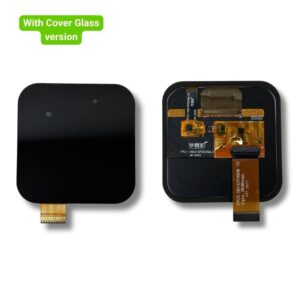
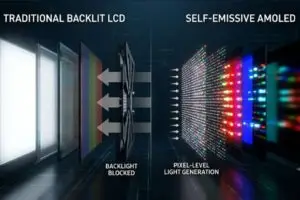
Polarizers are essential LCD components, using stretched PVA and TAC films to control light polarization, enabling image display through specialized materials, coatings, and manufacturing processes.
1. Working Principle of Polarizers
A polarizer (Polarizing Film) is an optical film that controls the polarization direction of light. When natural light passes through a polarizer, the component of light vibrating perpendicular to the transmission axis is absorbed, while only the component vibrating parallel to the transmission axis is transmitted as polarized light.
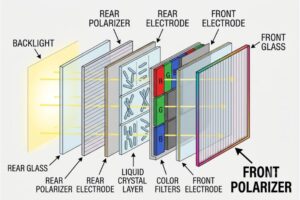
In an LCD module, two polarizers are attached to opposite sides of the glass substrates. The lower polarizer converts the light emitted by the backlight unit into polarized light. The upper polarizer analyzes the polarized light after it has been electrically modulated by the liquid crystal layer, creating brightness contrast and ultimately generating visible images.
Image formation in LCD modules relies entirely on polarized light. Without either of the two polarizers, the LCD module cannot display images.
The basic structure of an LCD module is shown below:

2. Basic Structure of Polarizers
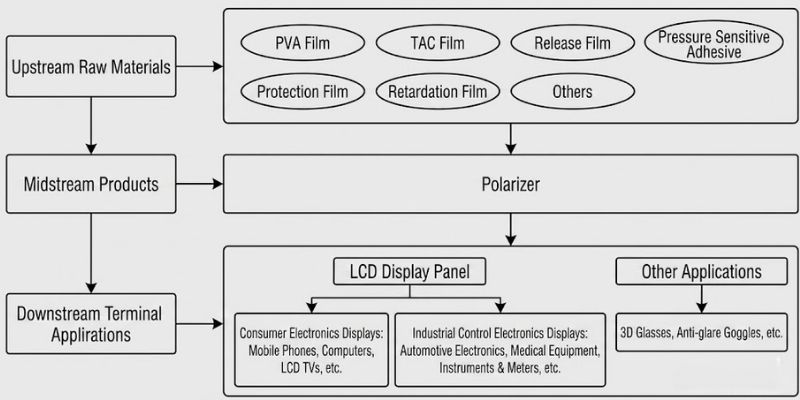
A polarizer is primarily composed of a PVA film, TAC films, protective film, release film, pressure-sensitive adhesive (PSA), and other laminated materials.
The basic structure of a polarizer is shown below:
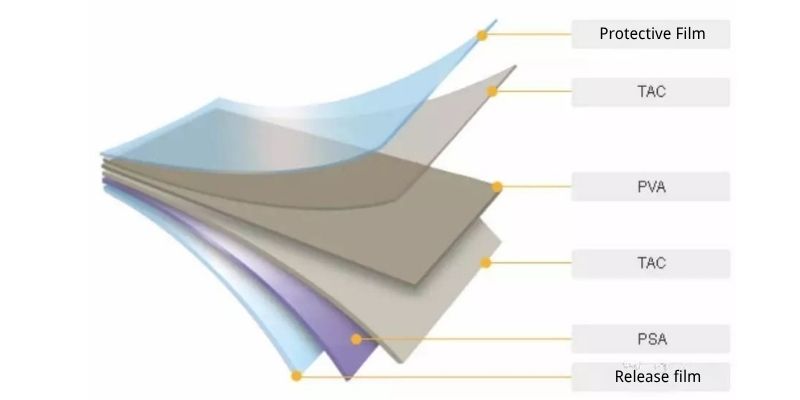
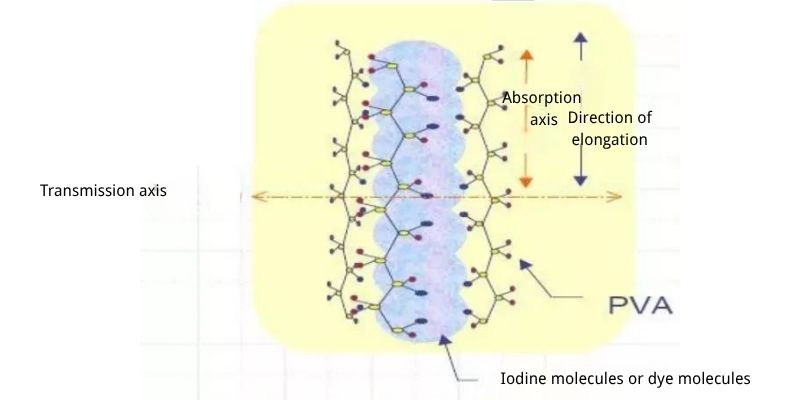
The core material responsible for polarization is the PVA (Polyvinyl Alcohol) film. After dyeing, the PVA film absorbs iodine molecules with dichroic absorption properties. Through stretching, the iodine molecules become uniformly aligned along the PVA molecular chains, forming a polarizing film with uniform dichroic absorption characteristics. The transmission axis is perpendicular to the stretching direction.
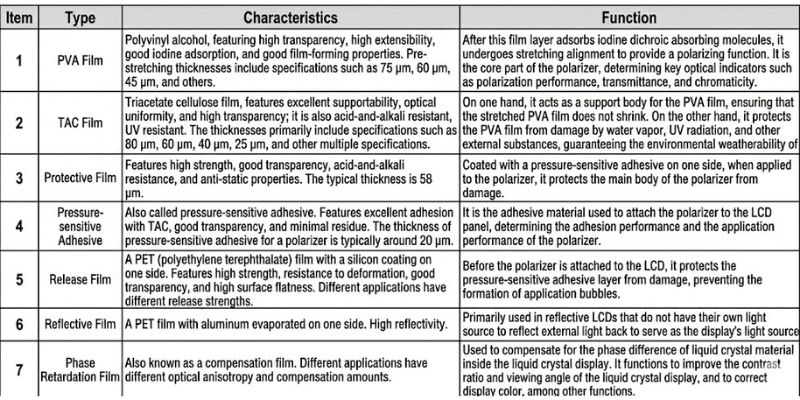
The key characteristics and functions of the major film materials used in polarizers are summarized in the table below:
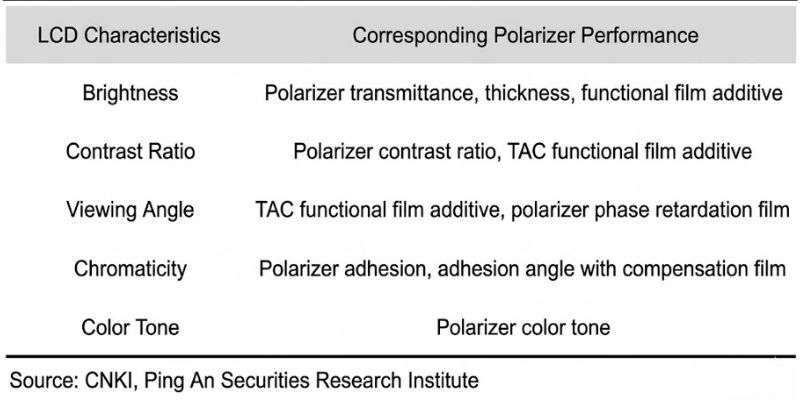
LCD panel performance is closely related to the quality of the polarizer.
From a cost perspective, PVA film and TAC film account for the largest share of raw material costs in a polarizer. TAC film represents approximately 50% of the total material cost, while PVA film accounts for around 12%.
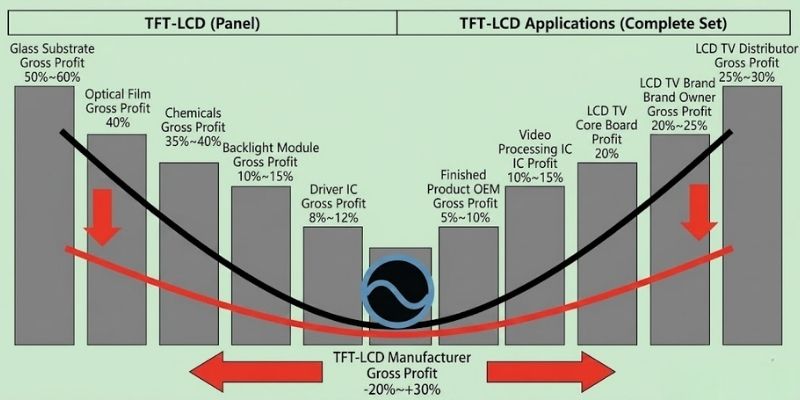
Throughout the display industry supply chain, polarizers generally maintain relatively healthy profit margins.
PVA Film: The Core Material for Polarization
PVA (Polyvinyl Alcohol) film is primarily composed of lightweight elements such as carbon, hydrogen, and oxygen, giving it excellent optical transparency and high elongation properties.
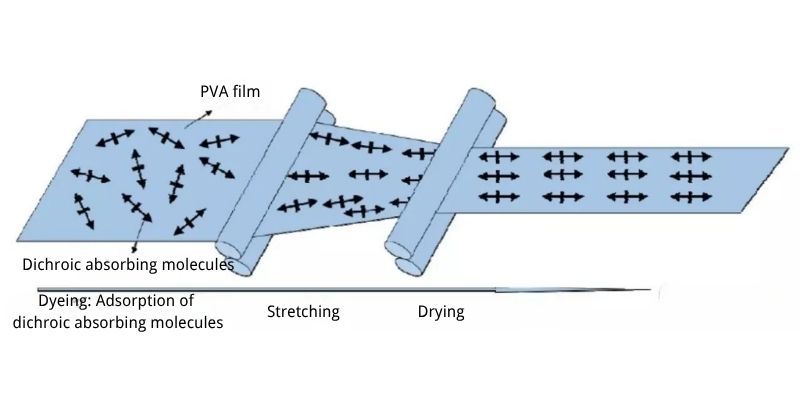
After dyeing, a uniform layer of iodine molecules (or dye molecules) accumulates on the surface of the PVA film. In its untreated state, the PVA molecular chains are randomly distributed, and the absorbed iodine (or dye) molecules are likewise randomly arranged.
When the PVA film is stretched, the molecular chains align in the direction of the applied force. The iodine (or dye) molecules also become orderly aligned, enabling the PVA film to function as a polarizing material.
Ordered Distribution of PVA Molecular Chains After Stretching
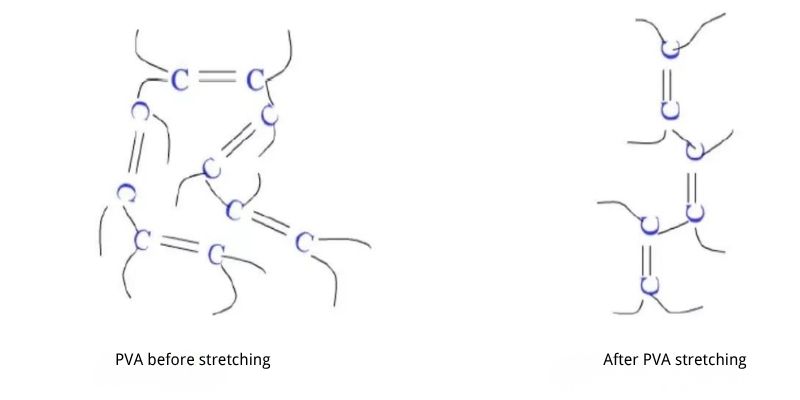
The stretching process and iodine molecular arrangement in PVA film are illustrated below:
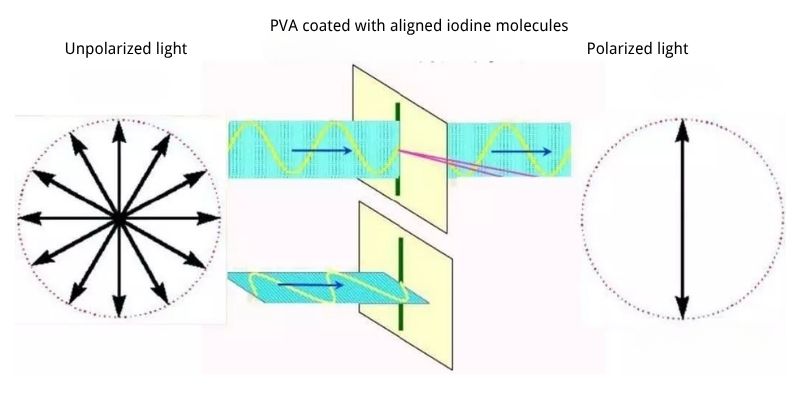
Between parallel iodine (or dye) molecules, there are uniformly aligned gaps. These gaps allow light polarized in the same direction as the molecular alignment to pass through while blocking light polarized in other directions. As a result, unpolarized light is filtered into polarized light.
Conversion of Unpolarized Light into Polarized Light
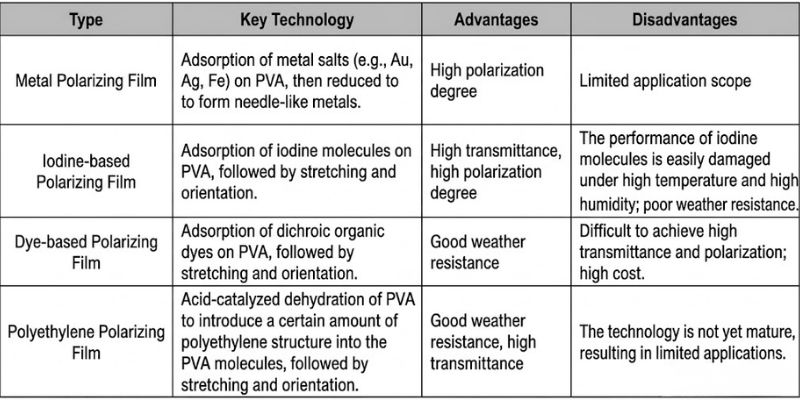
Based on the type of dichroic molecules used in the PVA film, polarizers available on the market can generally be classified into:
- Metal-based polarizers
- Iodine-based polarizers
- Dye-based polarizers
- Polyethylene polarizers
Among these, iodine-based polarizers offer high transmittance and high polarization efficiency and are currently the most widely used.
Dry and Wet Stretching Processes
Stretching the PVA film is the most critical step in polarizer manufacturing.
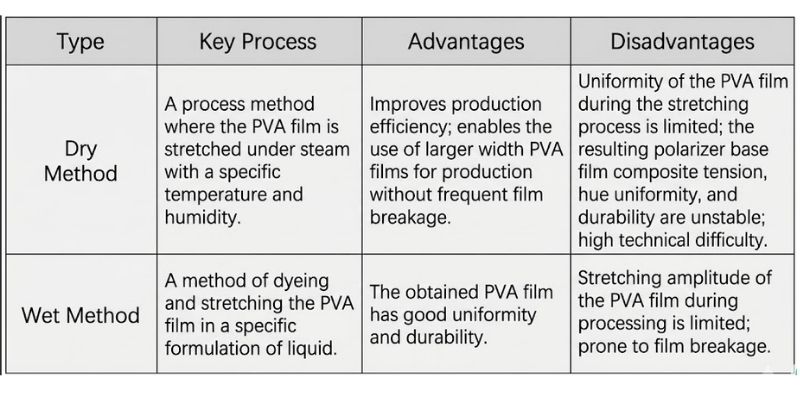
According to the stretching method, production can be divided into:
- Dry Process: PVA film is stretched in a controlled steam environment at elevated temperature.
- Wet Process: PVA film is stretched in a solution with a specific liquid composition.
Wet-process production provides superior uniformity and durability and is therefore adopted by most polarizer manufacturers.
In the finished polarizer, the area of the polarizer theoretically equals the area of the PVA film. However, because the PVA film must be pre-treated and stretched during production, approximately 0.5 square meters of PVA film are consumed for every square meter of finished polarizer produced.
Currently, the global PVA film market is largely dominated by Kuraray of Japan, which is also one of the world’s leading suppliers of high-end PVA resin materials. Kuraray’s dominant position in optical PVA films stems from its vertically integrated production system, covering:
- High-grade PVA resin production
- PVA film manufacturing for polarizers
- Surface treatment of PVA films
According to Kuraray, the company supplies approximately 40% of the world’s PVA resin and about 80% of the global PVA film used in polarizers.
TAC Film: An Irreplaceable Material
TAC (Triacetyl Cellulose) film is produced through processes including dissolution, filtration, plasticization, casting, and drying of TAC resin. It offers excellent optical uniformity, transparency, acid and alkali resistance, and UV resistance.
TAC Film Manufacturing Process
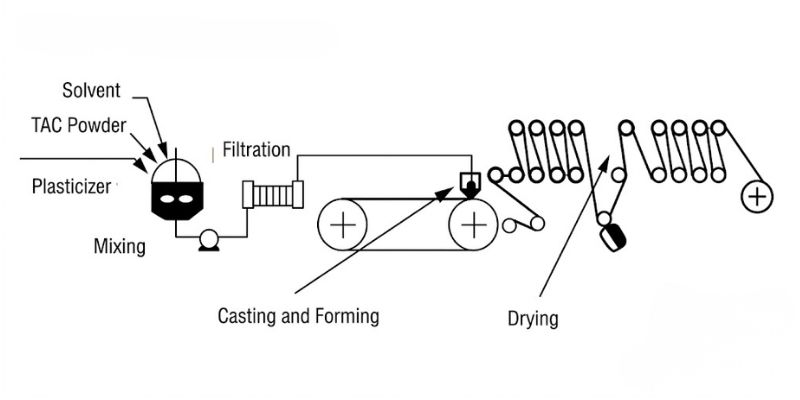
The TAC films used in polarizer production require exceptionally high quality standards. Manufacturing parameters must be precisely controlled to achieve superior flatness, mechanical strength, and optical performance.
Common TAC film thicknesses include:
- 40 μm
- 50 μm
- 57 μm
- 80 μm
Among these, 50 μm and 80 μm are the most widely used specifications.
TAC films used in polarizers are generally classified into two categories:
1. Plain TAC Film
Used in the inner layers of polarizers. These are untreated TAC base films without additional coatings or surface modifications.
2. Functional TAC Film
Used in the outermost layer of polarizers. These films undergo coating, sputtering, or other surface treatment processes to provide additional functionality.
Common surface treatments include:
- Anti-Glare (AG)
- Anti-Glare + Low Reflection (AG + LR)
- Clear Hard Coat + Low Reflection (CHC + LR)
- Clear Hard Coat (CHC)
- Anti-Reflection (AR)
Different treatments are designed to meet different end-user application requirements. For example, CHC treatment is commonly used in touch-enabled mobile devices.
Surface Treatment Requirements by Application
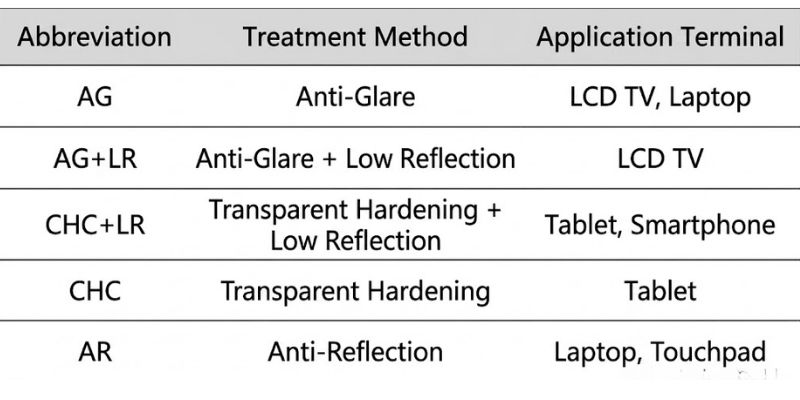
Most surface treatments involve adding a functional coating layer to a plain TAC film.
For example:
- AR Treatment: Applies a coating that causes incident and reflected light waves to interfere destructively, thereby reducing reflections.
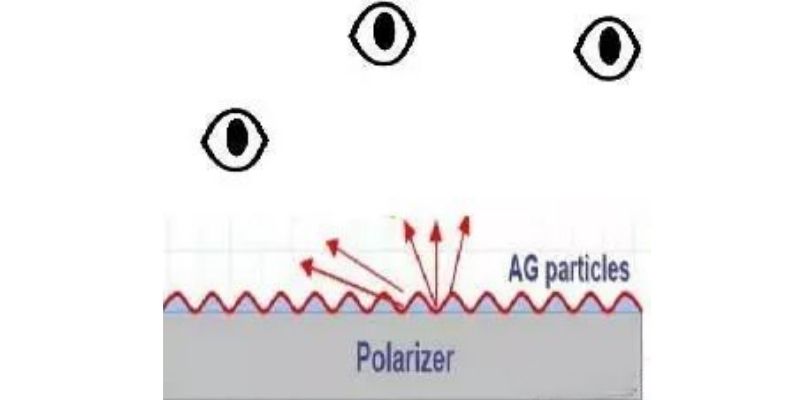
- AG Treatment: Creates microscopic surface irregularities that scatter light more uniformly, reducing glare.
AR Treatment Mechanism
AG Treatment Mechanism
Each LCD panel requires:
- 2 polarizers
- 2 TAC films per polarizer
Therefore, each LCD panel requires a total of 4 TAC films.
Functional TAC films are generally used only on the outermost surfaces.
Major TAC suppliers typically provide both plain and functional TAC films, including:
- Fujifilm
- Konica Minolta
- Nippon Paper
- Shinkong Synthetic Fibers
- Hyosung
Some companies purchase plain TAC films and perform their own surface treatments, such as:
- Dai Nippon Printing (DNP)
- TOPPAN
- Lintec
- Tomoegawa
In addition, some polarizer manufacturers, including:
- LG Chem
- Nitto Denko
possess in-house TAC film surface treatment capabilities to satisfy part of their own demand.
TAC Surface Treatment Supply Chain
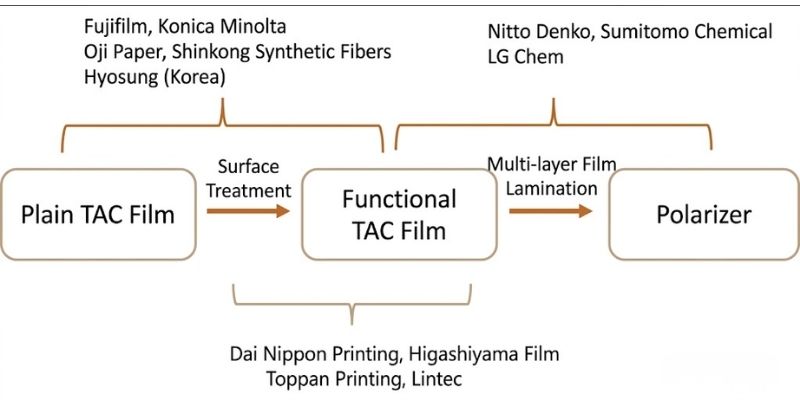
Although TAC manufacturers, coating companies, and polarizer manufacturers all possess certain coating technologies, each company has unique strengths.
Examples include:
- Dai Nippon Printing (DNP): Industry leader in high-definition AG films with more than 70% market share.
- TOPPAN and Nippon Paper: Strong expertise in CHC coatings.
- TOPPAN: Industry leader in dry-process AR film production.
- LG Chem: Capable of producing AG films internally, though development of other coating technologies continues.
- Companies such as Optimax, Sunboon Optical, and Sanlipu have not yet mastered TAC surface treatment technology.
Because these technologies diffuse slowly throughout the industry, companies possessing specialized TAC treatment expertise enjoy significant competitive advantages.
Technology Advantages by Company
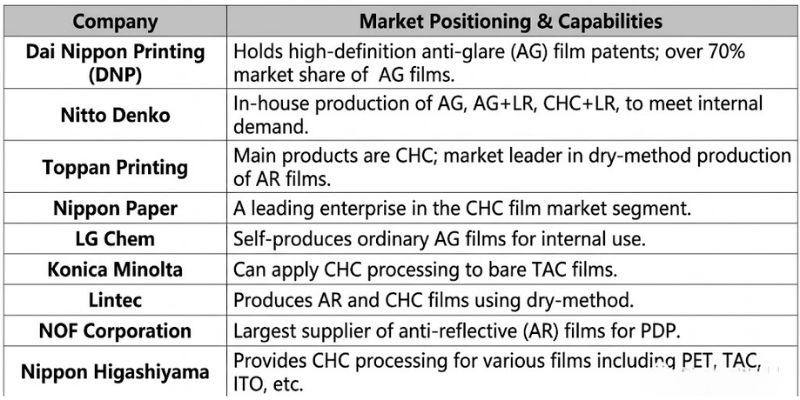
TAC Film Cleaning and PVA Film Stretching/Lamination: Core Polarizer Manufacturing Processes
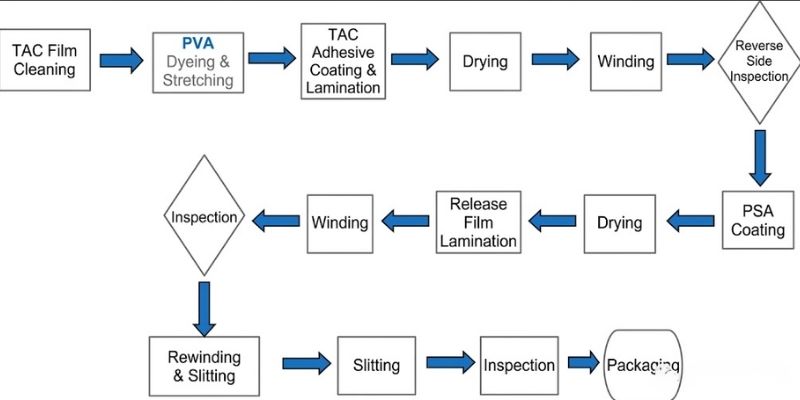
Iodine-Based Polarizer Production Technology and Wet Stretching Process
Front-End Process (TAC Film Cleaning and PVA Stretching/Lamination)
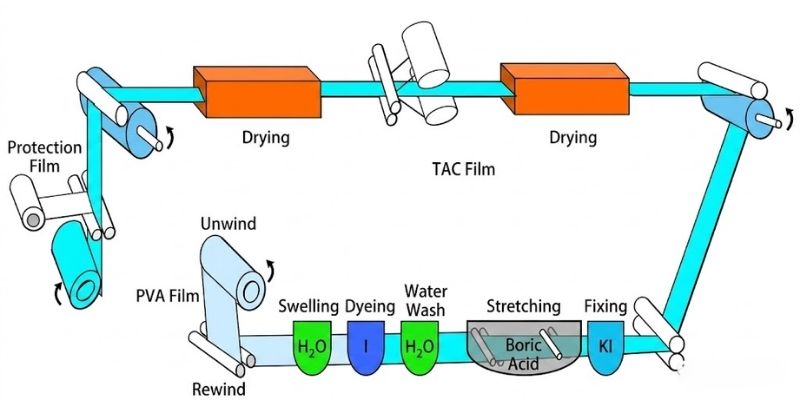
The front-end process includes TAC film pretreatment and PVA film stretching/lamination.
TAC film pretreatment involves alkaline treatment, followed by washing to remove residual alkali, drying, and rewinding. The primary purpose is to reduce the contact angle of the TAC surface and improve adhesion to the PVA film.
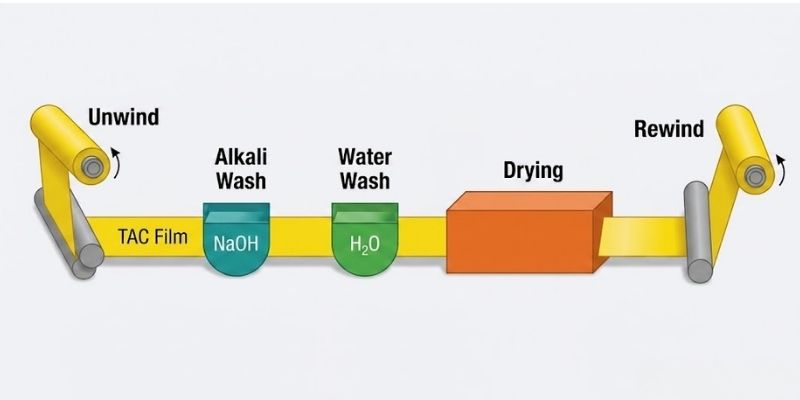
The PVA stretching and lamination process involves:
- Swelling the PVA film in purified water.
- Immersing it in a dye bath to absorb dichroic iodine molecules.
- Stretching the film in a stretching tank to orient the iodine molecules.
- Drying the stretched film.
- Laminating it between two pretreated TAC films.
This process produces the polarizing film.
Intermediate Process (Coating and Lamination Line)
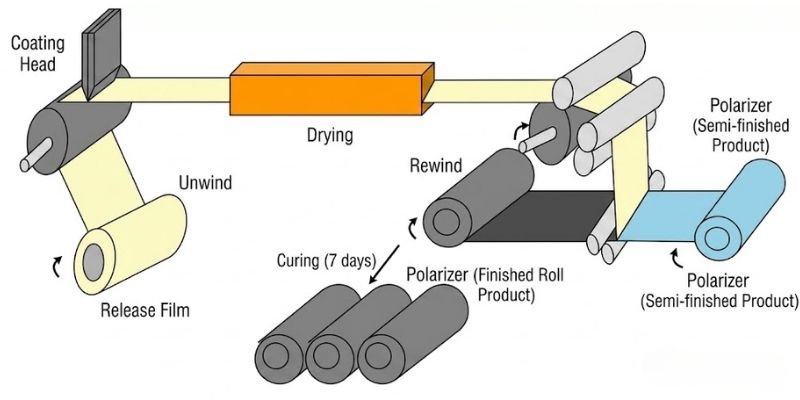
The intermediate process includes PSA coating and lamination of release films and other optical films.
The process involves:
- Coating pressure-sensitive adhesive onto a release film.
- Drying the adhesive in an oven to remove moisture.
- Laminating the adhesive-coated film with the polarizing film produced in the front-end process.
- Rewinding the laminated material.
- Curing in a constant-temperature curing chamber.
Depending on product requirements, additional optical films may also be laminated.
Back-End Process (Cutting Line)
The cured polarizer is then processed according to required dimensions through:
- Cutting
- Edge grinding
- Cleaning
- Inspection
- Packaging
3. Main Product Characteristics and Application Fields
The key performance indicators of polarizers can be categorized into three aspects:
Optical Properties
These include:
- Light transmittance
- Polarization efficiency
- Color tone
Mechanical Properties
These include:
- Polarizer warpage
- Adhesive bonding strength
Reliability
Reliability measures the durability of the polarizer.
Evaluation methods typically involve exposing the polarizer to environmental stress conditions such as:
- High temperature
- Low temperature
- High temperature and high humidity
After a specified testing period, changes in appearance and optical performance are examined and assessed.
The polarizer industry supply chain is illustrated below: