Global display panel market grows at 6.8% CAGR to 2035, driven by OLED adoption, automotive demand, and innovation, despite supply chain challenges and pricing pressure.
Display Panel Market Overview
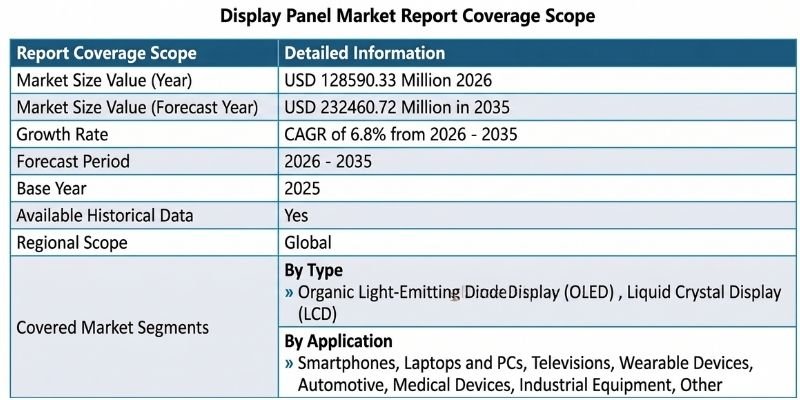
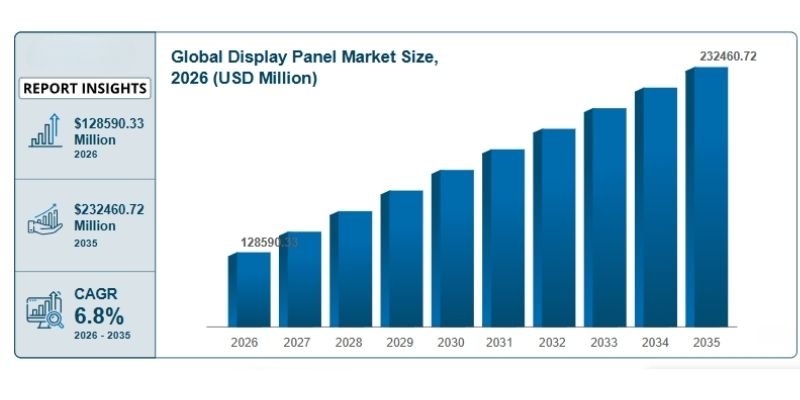
The global display panel market is projected to reach USD 128.59 billion in 2026 and grow to USD 232.46 billion by 2035, registering a compound annual growth rate (CAGR) of 6.8%.
Display panels form a critical part of the global electronics and semiconductor ecosystem, enabling applications across consumer electronics, automotive systems, industrial automation, healthcare, retail, and commercial infrastructure. Core technologies include LCD, OLED, Micro-LED, Mini-LED, and emerging quantum dot displays used in devices such as smartphones, televisions, laptops, monitors, digital signage, and vehicle dashboards.
By 2024, more than 92% of smartphones shipped globally featured advanced flat-panel displays, while over 78% of televisions were equipped with HD or UHD panels. Manufacturing remains highly concentrated in East Asia, accounting for nearly 85% of global production, supported by economies of scale and vertically integrated supply chains.
Demand from OEMs, system integrators, and automotive suppliers continues to drive the market, with industrial-grade panels representing approximately 18% of total shipments. Increasing panel sizes, higher pixel densities, and growing demand for low-power and flexible displays are shaping procurement strategies.
In the United States, the market is driven primarily by downstream demand rather than large-scale manufacturing. China accounts for roughly 21% of global consumption, led by consumer electronics and automotive applications. Meanwhile, the U.S. leads in innovation, contributing nearly 34% of global display-related patents annually.
Key Market Insights
- Primary Demand Drivers: Smartphones & TVs (47%), IT displays (21%), automotive displays (18%), industrial & medical (14%)
- Key Constraints: Raw material volatility (36%), supply chain disruptions (29%), energy costs (21%)
- Emerging Trends: OLED (41%), Mini-LED (19%), Micro-LED pilots (6%), flexible displays (34%)
- Regional Distribution: East Asia (83%), North America (9%), Europe (6%), Rest of World (2%)
- Market Structure: Top 5 manufacturers (62%), mid-tier (24%), niche players (14%)
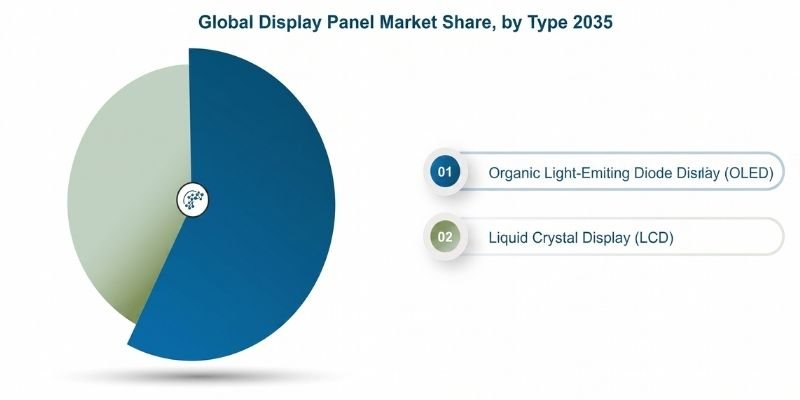
- Technology Mix: LCD (52%), OLED (38%), others (10%)
Latest Trends in the Display Panel Market
The industry is shifting toward premium display technologies and application-specific customization.
OLED panels now represent approximately 38% of total shipments, driven by strong demand in smartphones and high-end televisions. At the same time, Mini-LED backlighting is improving brightness levels by over 40%, accelerating adoption in gaming and professional displays.
Automotive displays are also expanding rapidly. Over the past five years, the average display area per vehicle has increased by nearly 65%, with curved and panoramic displays becoming standard in mid- to high-end models.
High refresh rates are becoming mainstream, with more than 57% of gaming monitors supporting 144Hz or higher. Improvements in energy efficiency have reduced average panel power consumption by 22%, aligning with sustainability goals.
Meanwhile, demand for high-brightness rugged displays is growing in industrial and outdoor environments, often exceeding 1,500 nits. Flexible and foldable displays now account for about 8% of smartphone panel shipments, indicating steady adoption.
Market Dynamics
Growth Drivers: Expanding Smart Display Demand
The increasing integration of digital displays across consumer electronics and vehicles remains the primary growth driver.
- Global smartphone shipments exceed 1.25 billion units annually
- Automotive displays now account for over 70% of in-vehicle systems
- Digital signage installations have surpassed 52 million units worldwide
Enterprise buyers continue to prioritize reliability, brightness, and lifecycle support, strengthening long-term demand.
Market Restraints: Cost and Supply Chain Complexity
The display panel industry is highly capital-intensive and dependent on complex global supply chains.
- Advanced manufacturing facilities require multi-billion-dollar investments
- OLED production yield loss can exceed 15%
- Component shortages have disrupted up to 28% of shipments
- Energy costs account for nearly 40% of production expenses
These factors limit short-term flexibility and profitability.
Opportunities: Industrial and Medical Expansion
Non-consumer applications are creating new growth opportunities.
- Industrial automation is driving demand for HMI displays
- Hospitals replace medical displays every 6–8 years
- Smart city projects have increased outdoor display installations by 32%+
- Interactive displays in education exceed 45% adoption in developed markets
These segments offer stable, long-term contracts and higher margins.
Challenges: Pricing Pressure and Rapid Innovation
- LCD prices have declined by over 50% in the past decade
- Product lifecycles are shortening to 18–24 months
- OEMs demand customization without proportional price increases
- Environmental regulations add compliance complexity
Continuous innovation and operational efficiency are essential to remain competitive.
Market Segmentation
By Type
OLED (Organic Light-Emitting Diode)
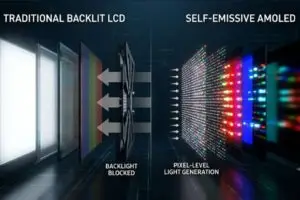
OLED panels are gaining traction due to superior contrast, self-emissive pixels, and flexible form factors.
- Used in 72% of premium smartphones
- Adopted in over 48% of high-end TVs
- Reduces power consumption by ~25% for dark content
- Flexible and foldable OLED accounts for 11% of shipments
- Automotive OLED usage is growing (approx. 9% share)
Despite advantages, manufacturing yield remains lower than LCD, with defect losses averaging 12%.
LCD (Liquid Crystal Display)
LCD remains the dominant technology, accounting for over 55% of active displays globally.
- Used in 82% of laptops and monitors
- Dominates 76% of digital signage installations
- Enhanced by Mini-LED (brightness +45%, contrast +35%)
- Lower burn-in risk, suitable for 24/7 operations
- Power consumption reduced by 18% vs previous generations
By Application
- Smartphones (46%) – High refresh rates, HDR adoption, larger screens
- Televisions (22%) – Growth in UHD and large-format displays
- Laptops & PCs (17%) – Focus on color accuracy and durability
- Automotive (9%) – Rapid adoption of digital dashboards
- Wearables – OLED dominates (69%), compact and efficient
- Medical Devices (4%) – High precision and long lifespan
- Industrial Equipment – Rugged, high-brightness, long lifecycle
- Others – Retail kiosks, aviation, gaming, education
Regional Outlook
Asia-Pacific
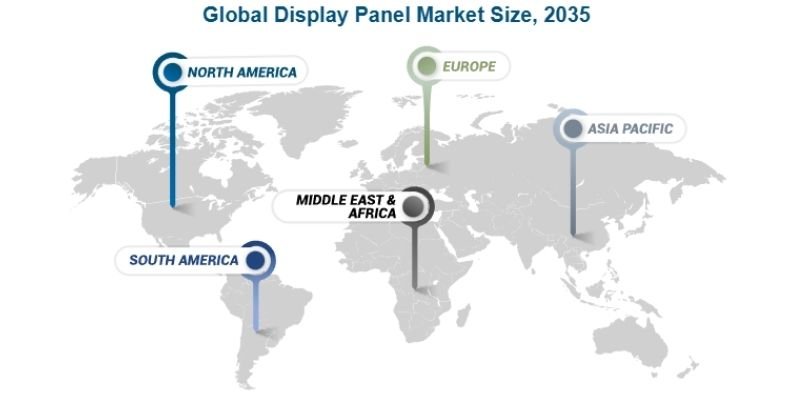
The dominant region, accounting for over 78% of production and 71% of consumption, driven by strong manufacturing capabilities and demand for smartphones and TVs.
North America
Represents approximately 11% of global demand, characterized by high adoption of advanced technologies in automotive, healthcare, and enterprise applications.
Europe accounts for around 9% of global usage, supported by automotive manufacturing and industrial automation, with a strong focus on energy efficiency.
Middle East & Africa
Contributes roughly 4% of global demand, driven by infrastructure development and increasing adoption of consumer electronics.
Key Companies in the Market
- Samsung Electronics
- BOE Technology Group
- LG Display
- AU Optronics
- Innolux Corporation
- Sharp Corporation
- Japan Display Inc.
Market Leaders:
- Samsung: ~29% share in high-resolution and OLED panels
- BOE: ~27% of global production
Investment Outlook
The display panel market continues to attract strong investment due to its strategic importance.
- 62% of manufacturers are increasing capital investment
- 58% of expansion focuses on OLED and advanced LCD
- Automation improves efficiency by 21%
- 44% of investments target energy-efficient manufacturing
Emerging sectors such as smart infrastructure, medical imaging, and industrial automation are generating new opportunities.
Innovation and Product Development
- 46% of new panels deliver 35% higher brightness
- 29% support 144Hz+ refresh rates
- Energy consumption reduced by 24%
- Growth in flexible, curved, and rugged displays
Recent Developments (2023–2025)
- OLED production capacity increased by 22%
- Mini-LED adoption reached 31% in large displays
- Automotive display standardization increased by 26%
- Manufacturing energy use reduced by 19%
- Custom industrial and medical displays grew by 23%
Final Takeaway
The display panel market is positioned for steady long-term growth, driven by innovation, diversification, and expanding applications across industries. While cost pressures and rapid technological change remain challenges, opportunities in automotive, healthcare, and industrial sectors continue to strengthen the market outlook.