Explore the intricate ecosystem of the OLED industry, from upstream raw materials to downstream applications, and analyze the strategic regional clusters driving global display innovation.
As display technology shifts toward thinner, more flexible, and higher-contrast solutions, Organic Light-Emitting Diode (OLED) technology has become the cornerstone for next-generation hardware. From high-end smartphones and smart wearables to advanced medical monitors and industrial interfaces, the OLED supply chain is a complex web of specialized manufacturers and regional hubs. For Product Managers and Hardware Engineers, understanding this landscape is critical for ensuring supply chain resilience and component optimization.
The OLED Supply Chain: From Raw Materials to Global Integration
The OLED industry structure is divided into three distinct segments: upstream, midstream, and downstream. The upstream segment involves the production of precision manufacturing equipment, high-purity organic materials, and assembly components. Midstream operations focus on the high-tech process of OLED panel fabrication, while the downstream encompasses the wide array of terminal applications that bring the technology to consumers and industries.
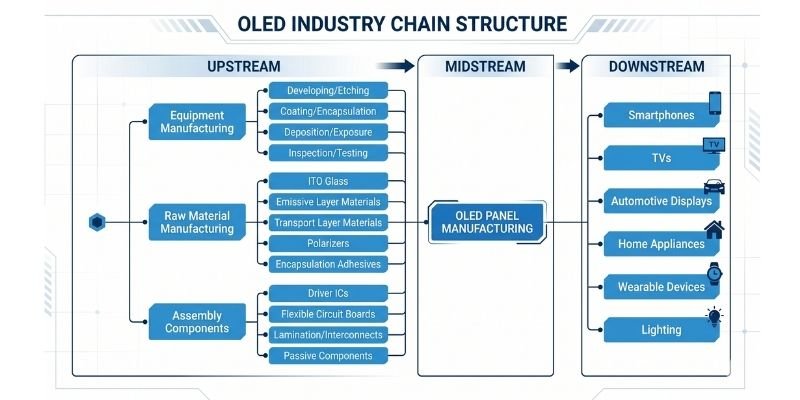
Upstream players include specialized firms such as Aoled, Light Grade, and Tunghsu Optoelectronic, which provide the essential building blocks. The midstream is dominated by industry giants, including BOE, Tianma, and CSOT, who manage the capital-intensive panel manufacturing process.
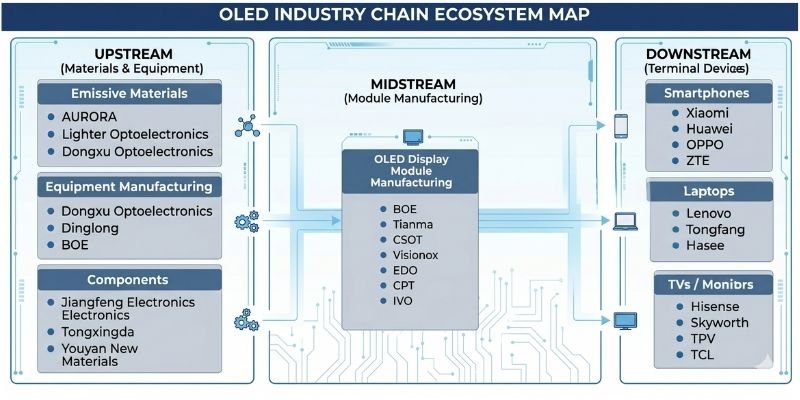
Regional Strategic Mapping: Concentration in Innovation Hubs
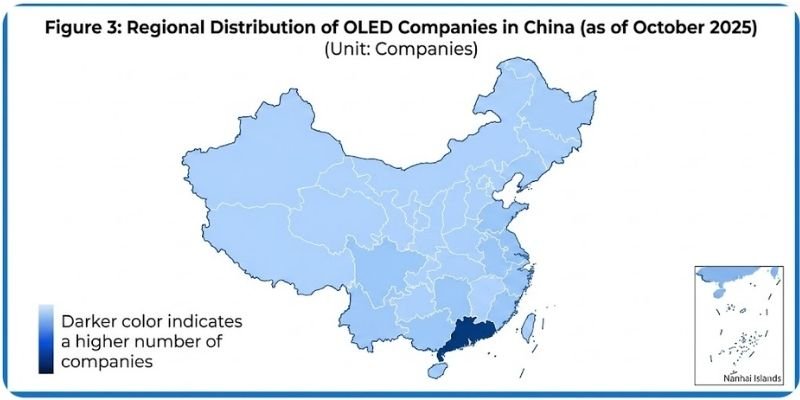
Data reveals that OLED manufacturing and R&D are highly concentrated in specific industrial corridors. According to recent enterprise data, Guangdong Province serves as the primary epicenter, hosting over 2,100 OLED-related enterprises as of late 2025. Jiangsu follows as a secondary hub with over 400 specialized firms.
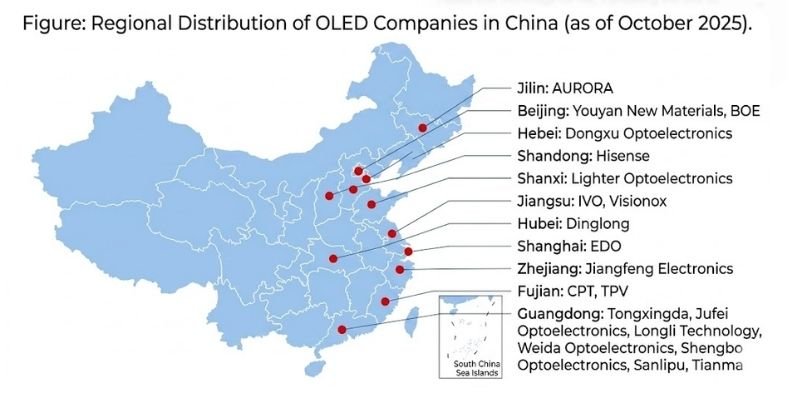
This geographical clustering allows for rapid prototyping and localized supply chains, particularly in the Guangdong-Hong Kong-Macao Greater Bay Area. Beyond Guangdong and Jiangsu, significant clusters are also found in Shanghai, Beijing, and Hubei, where leading representative enterprises leverage regional academic and logistical advantages.
Market Performance and Product Diversification
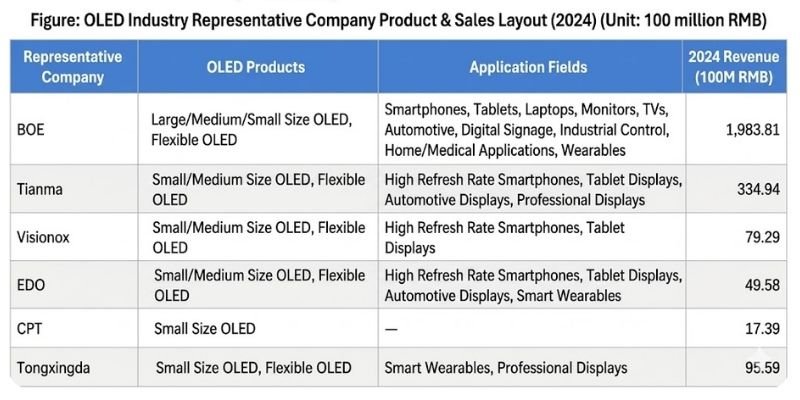
The competitive landscape is led by major players who have successfully diversified their product portfolios across multiple sectors. BOE remains the market leader in terms of revenue and application breadth, reporting revenues of 198.38 billion RMB. Their reach spans from consumer electronics to specialized industrial displays, setting the benchmark for the industry.
Strategic Investment Trends for 2025-2030
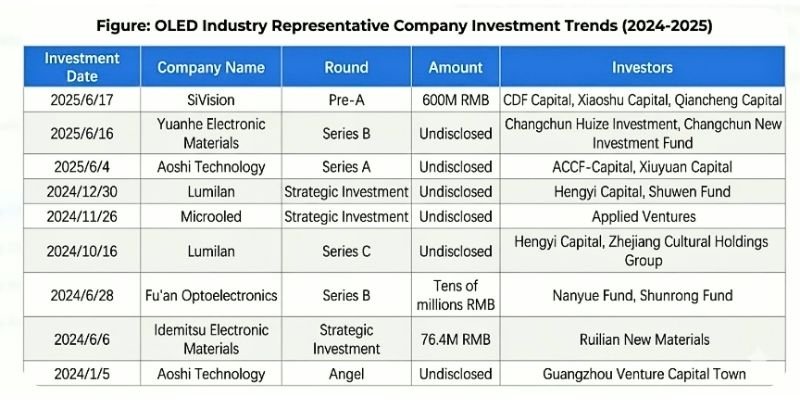
Recent investment activities indicate a shift toward consolidation and technological expansion. Leading firms are increasingly acquiring niche technology providers to bolster their IP portfolios or increasing capital in subsidiaries to accelerate the production of high-performance panels (such as LTPO and Tandem OLED)[Chart 6: 2024-2025 Key Investment Trends in the OLED Sector]
Conclusion
The OLED industry is entering a phase of mature expansion. For hardware innovators, the concentration of the supply chain in specific regional hubs like Guangdong offers opportunities for closer collaboration and faster development cycles. As leading manufacturers continue to invest in next-gen production lines, the availability of high-performance, cost-effective OLED solutions for medical, industrial, and wearable applications is set to reach new heights.
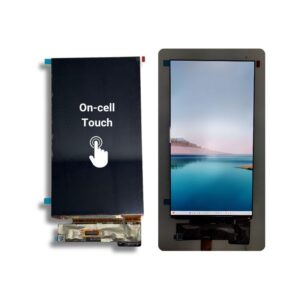
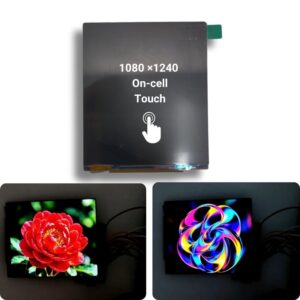
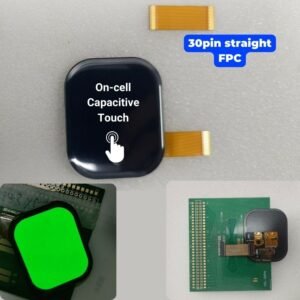
Tailor Pixels is located in the Guangdong area. As an OLED module manufacturer and supplier, we serve our application customers not only in this area, but also internationally. If you have a project with OLED requirements, please feel free to reach out to us at [email protected]. Want to know more about our related products? You can visit OLED Display – Tailor Pixels
-300x300.jpg)